Proposed area / Designed for Machines, Not Humans.
Autonomous Logistics
Designed for Machines, Not Humans
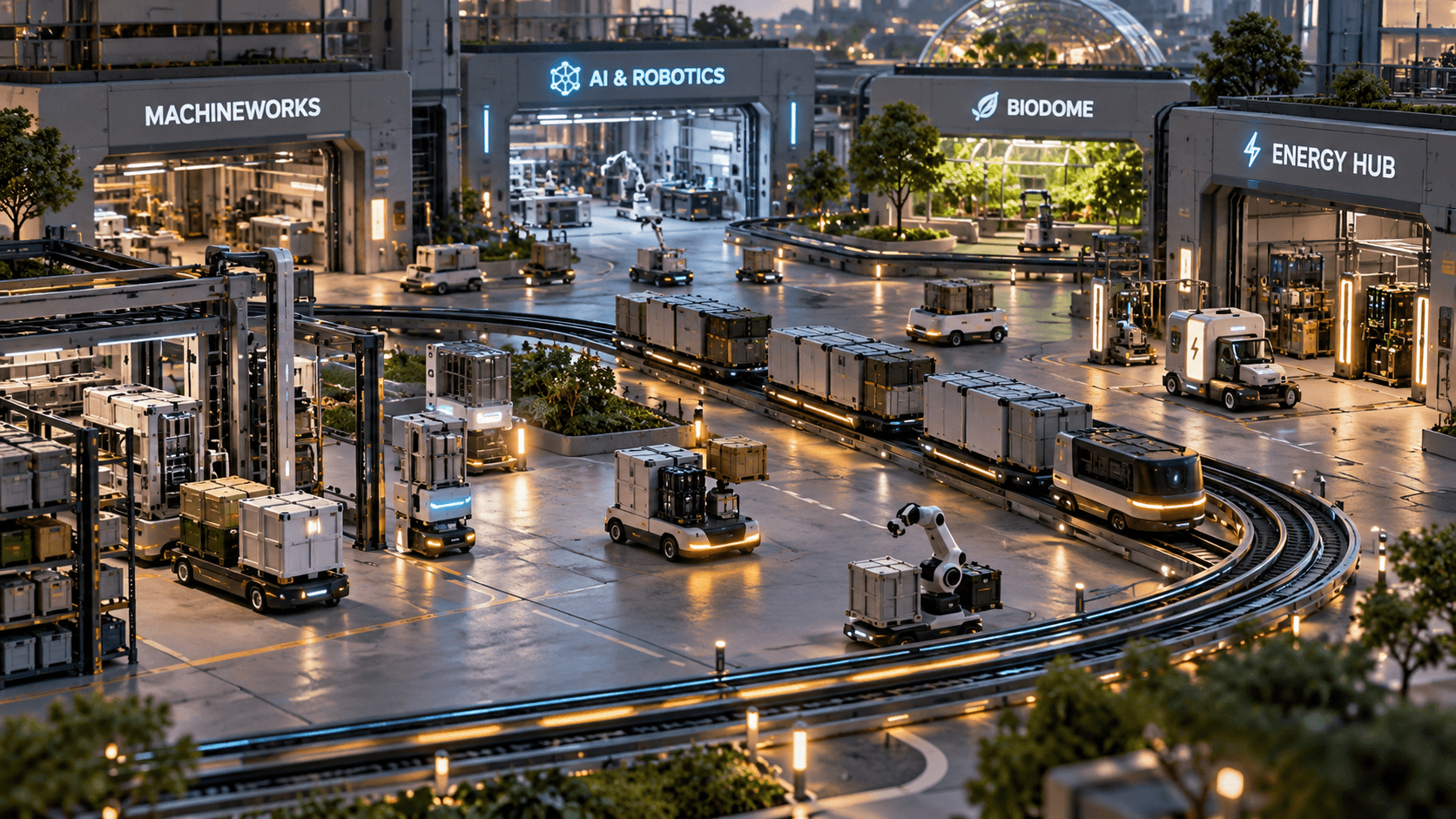
In City of Machines, logistics is not simply about moving goods. It is about creating an intelligent transportation ecosystem designed specifically for autonomous machines and their operational needs.
Unlike conventional logistics systems built around human dimensions, vehicles, and infrastructure, City of Machines explores an alternative approach: machines and transportation networks designed for maximum efficiency within an increasingly autonomous environment.
Purpose-Built Autonomous Vehicles
Transportation machines will be developed according to their specific tasks, carrying capacity, dimensions, and energy requirements.
Some vehicles may be extremely small, transporting electronic components, tools, or lightweight materials. Others may handle heavier loads or specialized industrial operations.
By eliminating unnecessary human-oriented design constraints, the city can develop compact, efficient machines that require less space, fewer materials, and potentially lower initial investment.
Mobile Energy — PowerBank Vehicles
Autonomous mobile energy units could transport stored electrical energy throughout the city.
These specialized vehicles may deliver rechargeable battery modules, support machines operating away from fixed charging stations, or provide temporary energy where needed.
The objective is to explore flexible energy distribution as part of the city's autonomous infrastructure.
Autonomous Rail Networks
Small-scale electric rail systems could connect production facilities, storage areas, energy stations, and other sectors of City of Machines.
A compact circular railway could provide a reliable transportation route around the city, while smaller autonomous vehicles handle local distribution.
Such systems could initially be constructed on a modest scale and expanded as the city grows.
Intelligent Coordination
Artificial intelligence will play an increasing role in coordinating vehicle movements, planning transportation routes, managing available energy, and distributing materials between sectors.
The long-term goal is a logistics network capable of adapting to changing demands, identifying inefficiencies, and progressively improving its own operations under appropriate safety supervision.
Starting Small, Growing Autonomously
City of Machines does not need enormous industrial facilities or conventional transportation infrastructure from the beginning.
A small experimental environment containing compact autonomous vehicles, modular transport systems, and miniature rail networks could demonstrate the fundamental principles of machine-oriented logistics.
As the city develops, these systems can evolve into larger and more sophisticated networks.
The Long-Term Vision
Autonomous Logistics is envisioned as the circulatory system of City of Machines — connecting production, energy, robotics, storage, and research into a coordinated physical ecosystem.
The ultimate objective is not to automate human logistics, but to discover what logistics can become when an entire city is designed for autonomous machines.
Explore a connection.
Have a question or an idea connected to this area? Start a conversation with City of Machines.